




Industrial Tires For Aircraft Tugs: What Matters in Airport Ground Towing Operations?
Industrial Tires For Aircraft Tugs are built for a type of work that looks slow from a distance but is mechanically demanding at the tire. Aircraft tugs normally operate at relatively low speeds, yet they must transfer high pulling force, start and stop repeatedly, turn accurately in restricted areas, and remain predictable when moving valuable aircraft. These conditions make tire selection more complex than simply matching the outside diameter or choosing the highest available load rating. A suitable tire has to support the tug, maintain consistent contact with the apron, tolerate repeated steering stress, and continue doing so through long ground-support duty cycles.
Why Aircraft Tug Tires Face a Different Duty Cycle
A warehouse truck may move pallets through regular aisles, while an aircraft tug repeatedly changes direction around gates, hangars, parking stands, and service roads. The tug may spend much of its time traveling slowly, but low speed does not mean low tire stress. Starting a tow requires high torque at the tire-ground interface, and precise positioning often adds repeated braking and steering inputs within a short distance. That combination of load, torque, and frequent maneuvering creates a duty cycle in which traction and wear behavior matter as much as simple load capacity.
The towing task also changes from one operation to another. A tug may travel unloaded to an aircraft, connect, move under much higher resistance, stop for repositioning, and then return to another assignment. For Industrial Tires For Aircraft Tugs, the relevant question is therefore not only how much weight the vehicle carries but how the load and traction demand change across a complete towing cycle. Evaluating only a single static load figure can miss the conditions that actually create wear.
Traction Is About Controlled Force, Not Aggressive Speed
Aircraft tugs need predictable traction because the vehicle must transmit pulling force without unnecessary wheel slip. Excessive slip wastes traction, increases tread wear, and can make low-speed positioning less precise. At the same time, the tire must remain controllable during braking and turning, especially when operating close to aircraft, terminal equipment, or personnel. The objective is not to maximize grip in isolation, but to achieve stable contact that matches the tug, surface, and towing task.
Apron conditions can change throughout the day. Dry concrete, painted areas, dust, moisture, and surface contamination can all alter the tire-ground relationship. This is why the same tire may feel different on two airport routes even when the tug model is identical. When evaluating Industrial Tires For Aircraft Tugs, the working surface should be treated as part of the application rather than as background information.
Hard Apron Surfaces Can Accelerate Wear During Turning
Airport aprons are usually hard and durable, which is necessary for heavy ground traffic, but hard concrete and asphalt can be abrasive when a vehicle makes frequent low-speed turns. The tread is forced to scrub against the surface instead of simply rolling forward, and this friction is often concentrated at the shoulders. Over time, a tug that performs repeated tight turns may show shoulder wear even if its total travel distance is not especially high.
This wear pattern is useful information. If one tire position wears noticeably faster than the others, the cause may involve steering geometry, alignment, turning direction, or load distribution rather than the rubber compound alone. Replacing tires without reviewing the wear pattern can repeat the same problem. A better approach is to treat the removed tire as evidence of how the tug is actually being used.
Why Solid Tires Can Be Practical for Ground-Support Equipment
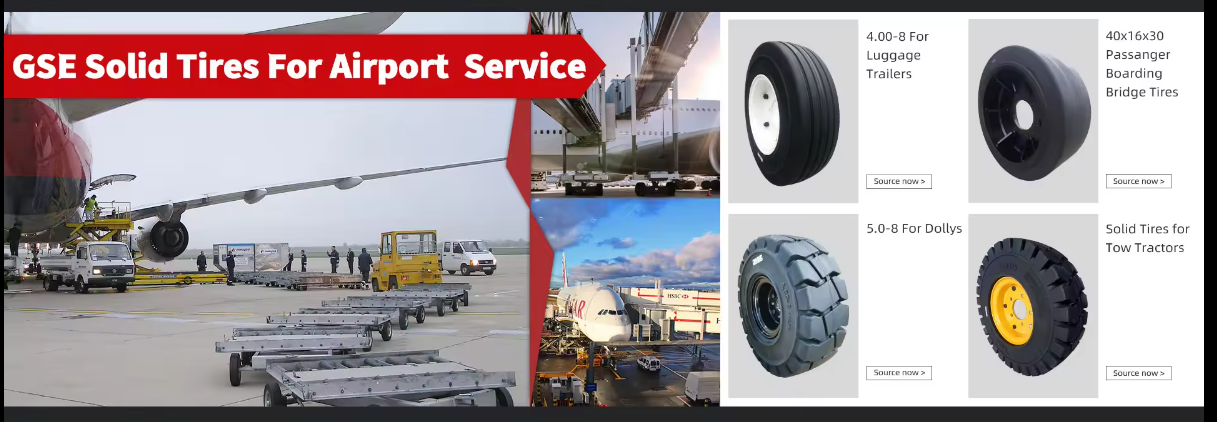
Airports maintain operating areas carefully, but ground-support zones can still contain small fasteners, metal fragments, or maintenance debris. A pneumatic tire exposed to a sharp object can lose pressure and take the tug out of service until the problem is repaired. Solid tire construction removes the pressurized air chamber, so a conventional puncture does not create the same sudden loss of inflation. For vehicles working on scheduled towing tasks, reducing that type of unexpected interruption can be valuable.
Solid construction does not mean the tire is immune to damage. Cuts, chunking, uneven wear, excessive heat, wheel damage, and poor fit can still affect performance. The advantage is narrower and more practical: the tire is no longer dependent on air pressure for basic operation. That distinction matters because it keeps the tire selection focused on the real ground-support problem rather than turning “puncture-proof” into an unrealistic promise.
Long Shifts Make Heat and Wear Accumulation More Important
Aircraft towing is usually a repeated-duty application rather than a single heavy pull followed by long rest. A tug may perform numerous towing and positioning cycles during one shift, with limited time for the tires to recover between assignments. Rubber deforms under load as the tire rotates, and that repeated deformation generates internal heat even when the surrounding air temperature is moderate. Heavy towing, frequent braking, and continuous operation can therefore raise thermal stress over time.
For this reason, daily operating hours and cycle frequency are important selection data. Two identical tugs can produce very different tire results if one performs occasional hangar movements while the other works continuously around busy gates. Travel distance, towing frequency, average load, and the number of tight turns should be considered together instead of being treated as separate specifications.
Stability and Predictable Handling Matter Near Aircraft
Ground-support vehicles work in spaces where small movement errors can have serious consequences, so consistent handling deserves attention. A tire that is heavily worn on one side, poorly matched to the wheel, or operating under an uneven load can change steering feel and vehicle behavior. These effects may be subtle, but precise low-speed positioning makes them more noticeable than they would be in an open industrial yard.
A practical tire program should therefore aim for consistency across wheel positions. Matching tire dimensions, maintaining wheel condition, checking wear at regular intervals, and investigating unusual differences between left and right sides can support more predictable tug behavior. Tire condition is only one part of safe towing, but it is a mechanical part that directly connects the tug to the ground.
What to Check Before Selecting Industrial Tires For Aircraft Tugs
Before changing tire type or specification, it helps to collect operating information rather than relying on equipment model alone. The most useful details usually include:
- Current tire size and wheel or rim specification
- Tug model and vehicle operating weight
- Typical towing duty and frequency of heavy pulls
- Apron surface, including wet or contaminated areas
- Daily operating hours and approximate travel distance
- Turning frequency and common maneuvering patterns
- Existing tire wear, cuts, shoulder damage, or heat-related symptoms
This information helps separate a fitment problem from an application problem. If the existing tires are wearing mainly at the shoulders, the solution may need to address turning stress. If repeated punctures are the main issue, solid construction may be more relevant. If the tire is overheating during long shifts, the duty cycle deserves closer attention.
Building the Tire Choice Around the Airport Application
The most suitable Industrial Tires For Aircraft Tugs are those matched to the actual towing environment rather than selected from a generic “heavy-duty” label. A tug used for occasional maintenance moves may not need the same tire characteristics as a unit operating continuously at a busy terminal. The right choice balances load support, traction, abrasion resistance, puncture resistance, thermal behavior, and wheel compatibility according to the real route and schedule.
WonRay provides industrial solid tire solutions for forklifts, ground-support equipment, and other material-handling vehicles. For aircraft tug applications, the useful starting point is to provide the existing tire size, tug model, operating load, apron condition, and current wear problem. This makes it possible to discuss a tire solution around the actual duty cycle instead of assuming that one construction fits every airport vehicle. If your tug tires are experiencing repeated punctures, rapid shoulder wear, or inconsistent service life, sharing those operating details is the fastest way to narrow down a more suitable option.
FAQ
Are Industrial Tires For Aircraft Tugs different from ordinary warehouse tires?
Yes. Aircraft tugs often combine low-speed high-torque movement, repeated towing cycles, tight maneuvering, and hard apron surfaces. Those conditions can create different traction, wear, and heat demands from ordinary warehouse work.
Why are solid tires useful for aircraft tugs?
Solid tires do not rely on inflation pressure, so conventional punctures do not cause sudden air loss. This can reduce one source of unexpected downtime in ground-support operations.
What causes shoulder wear on aircraft tug tires?
Frequent tight turning on hard concrete or asphalt can create strong lateral scrub at the tread shoulders. Alignment, load distribution, and steering geometry can also contribute.
What information helps with tire selection?
Tire size, wheel specification, tug model, working load, towing frequency, apron condition, daily operating hours, turning pattern, and current wear symptoms are all useful.