



Forklift Tires For Wet Surfaces: How to Improve Grip Without Creating New Tire Problems
Forklift Tires For Wet Surfaces are not simply ordinary forklift tires with a deeper tread. In warehouses, food plants, beverage facilities, cold-chain areas, loading docks, and production zones, the floor may change from dry to damp several times during one route. Water, condensation, washdown residue, or tracked-in moisture can reduce friction quickly, especially when the forklift is carrying a load, turning into a rack aisle, or braking near a workstation. A useful tire choice therefore has to address traction without creating excessive rolling resistance, rapid wear, or unstable handling on the dry parts of the same route.
wet-surface performance depends on the complete contact system: tire compound, tread condition, floor texture, contamination, vehicle load, speed, and operator route. A tire can perform well on wet textured concrete yet feel very different on smooth epoxy with detergent residue. Selecting Forklift Tires For Wet Surfaces is most effective when the actual floor problem is defined before the tire is changed.
Why Forklift Tires For Wet Surfaces Need More Than Deep Tread
Deep grooves can help move water away from the contact area, but tread depth alone does not determine grip. Industrial forklifts often work at relatively low speeds, where hydroplaning is usually less important than the friction available during braking, steering, and load transfer. Rubber compound, tread block stiffness, contact pressure, and the condition of the floor all influence how the tire behaves when moisture is present.
A very aggressive tread can also have disadvantages in mixed-use facilities. Large voids may increase vibration on smooth floors, reduce the amount of rubber in contact with the surface, or wear quickly when the truck spends most of the shift on dry concrete. For that reason, wet-floor tire selection should start with the dominant operating condition rather than assuming that the deepest pattern is always safest. The objective is controlled, repeatable traction through the whole route.
How Forklift Tires For Wet Surfaces Behave With Water, Oil, and Cleaning Residue
Not every “wet floor” is the same. Clean water on textured concrete creates one type of condition, while oil, syrup, coolant, detergent, or food-processing residue creates another. A tire that feels secure on a damp loading dock may still struggle on a smooth floor covered by a thin film of lubricant. This distinction is important because tire selection cannot fully compensate for a contaminant that should be removed through housekeeping or process control.
When a forklift repeatedly crosses a washdown zone, the operator may notice the first changes during braking or tight steering rather than during straight travel. If the same truck then enters a dry aisle, the tire must still roll efficiently and resist abrasion. This is why Forklift Tires For Wet Surfaces should be evaluated across the entire route instead of only at the wettest point. The best fit is usually the tire that handles the recurring combination of surfaces, not the tire optimized for one isolated section.
Map the Floor Before Blaming the Tire
A practical way to diagnose traction complaints is to mark the route and identify where slip events or unstable handling occur. The most useful observations are often simple: Is the floor polished or rough? Is moisture constant or only present after cleaning? Does the problem appear near doors where condensation forms? Does the forklift turn sharply in the wet zone, or does it approach in a straight line? Are loads heavier during the return trip?
Divide the route into dry, damp, frequently washed, contaminated, and transition zones. If problems are concentrated in one area, tire choice may matter, but drainage, cleaning timing, or route design may be equally important. If poor traction appears across several wet areas, the tire-floor match deserves more attention.

Load Transfer Changes Wet-Surface Traction
Forklifts do not place the same load on every tire at every moment. Lifting, braking, accelerating, and turning shift force through the chassis and change contact pressure at the wheels. When the vehicle carries a heavy load, the consequences of reduced friction become more noticeable because the truck needs predictable control while more mass is moving.
That is why tire selection should include actual load, not only nominal tire size. A tire may be dimensionally correct but poorly suited to the load and duty cycle. Repeated overloading can increase deformation and heat, while aggressive steering can accelerate shoulder wear. On wet floors, worn shoulders or hardened tread surfaces may further reduce confidence during turning. Maintaining proper load practice is therefore part of wet-surface performance, not a separate issue.
Traction and Rolling Resistance Must Be Balanced
It is tempting to judge a wet-surface tire only by how strongly it grips during a short test. In a real warehouse, however, the tire may run for many hours, and rolling resistance affects steering effort, energy use, heat generation, and overall tire wear. A compound or tread arrangement that creates unnecessary drag can solve one problem while producing another.
For electric forklifts, this balance becomes especially visible because repeated acceleration and long travel routes draw energy from the battery. For internal-combustion forklifts, increased resistance still affects heat and tire stress. The appropriate Forklift Tires For Wet Surfaces should provide enough traction for the actual wet sections while maintaining efficient, stable rolling through the rest of the shift.
Use Existing Wear Patterns as Evidence
Before replacing the current tires, inspect what they are already telling you. Smooth, polished tread surfaces can indicate long service on hard floors. Heavy shoulder wear may point to frequent tight turning. Cuts and chunks may reveal debris or rough floor edges. Uneven wear between left and right positions can suggest alignment, load distribution, or route effects rather than a simple compound problem.
Wet-floor complaints should also be compared with tread condition. A tire that originally provided acceptable grip may change after substantial wear. Recording operating hours and wear patterns helps distinguish normal replacement timing from an application mismatch.
A Practical Checklist for Forklift Tires For Wet Surfaces
Before deciding on a tire, collect information that describes the real operation rather than only the wheel size. The most useful points include:
- forklift model, tire size, and wheel or rim configuration;
- maximum and typical working load;
- floor material in both wet and dry sections;
- source of moisture, such as washdown, condensation, rain, or process fluid;
- daily operating hours and approximate travel distance;
- turning frequency, braking points, slopes, and dock transitions;
- current tire type, wear pattern, and any history of slipping or rapid wear.
This information makes it easier to separate traction requirements from other issues such as overloading, damaged floors, or unsuitable cleaning practices. It also helps avoid selecting a tire that performs well in the wet zone but wears too quickly everywhere else.
When a Solid Tire Makes Sense on Wet Industrial Routes
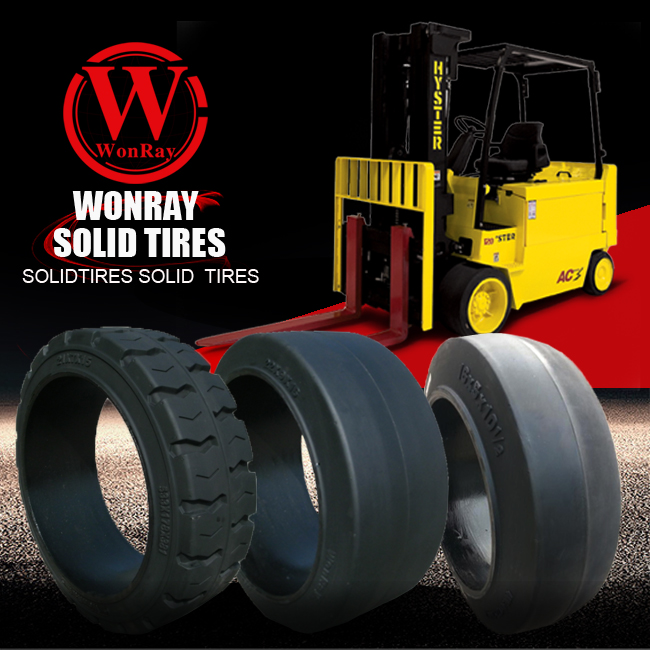
Solid tires are often considered when puncture resistance and low pressure maintenance are important. In wet industrial facilities, those benefits can be useful where the same route also contains metal fragments, pallet debris, or sharp objects. However, solid construction does not automatically create better wet traction. Tread design, compound, surface condition, and load still determine how the tire interacts with the floor.
Matching Forklift Tires For Wet Surfaces With WonRay
When wet-floor performance is part of a broader industrial tire problem, the selection process should connect tire size with load, route, floor, and working hours. WonRay supplies industrial solid tire solutions for forklift and material-handling applications and can use application information to help narrow the suitable tire direction. The purpose is not to choose a tire by one label such as “wet surface,” but to match the tire to the complete duty cycle.
For a more useful recommendation, provide the forklift model, current tire size, photos of the existing tire and floor, typical load, wet-area description, daily operating hours, and the problem you want to solve. If slipping, rapid wear, punctures, or heat are occurring together, include all of them rather than focusing on only one symptom. This gives the technical discussion a clearer starting point and helps move from a general tire search toward an application-specific solution.
FAQ
Are Forklift Tires For Wet Surfaces the same as non-marking tires?
No. Wet-surface tires focus on traction under moisture or contamination, while non-marking tires focus on reducing dark rubber marks on floors. One tire may address both needs, but the terms describe different requirements.
Does deeper tread always improve forklift grip on wet floors?
No. Tread depth is only one factor. Rubber compound, floor texture, load, wear condition, and the type of liquid on the floor also affect traction.
Can a solid forklift tire still slip on a wet floor?
Yes. Solid construction prevents conventional air-loss punctures, but it does not eliminate traction limits. The tire still needs to match the floor and operating condition.
What should be provided when requesting a wet-surface tire recommendation?
Provide tire size, forklift model, load, floor type, source of moisture, operating hours, travel route, and photos or descriptions of current wear and traction problems.